You Have a Website, a Google Listing, and Still No Calls, Here's the Trust Problem You're Missing
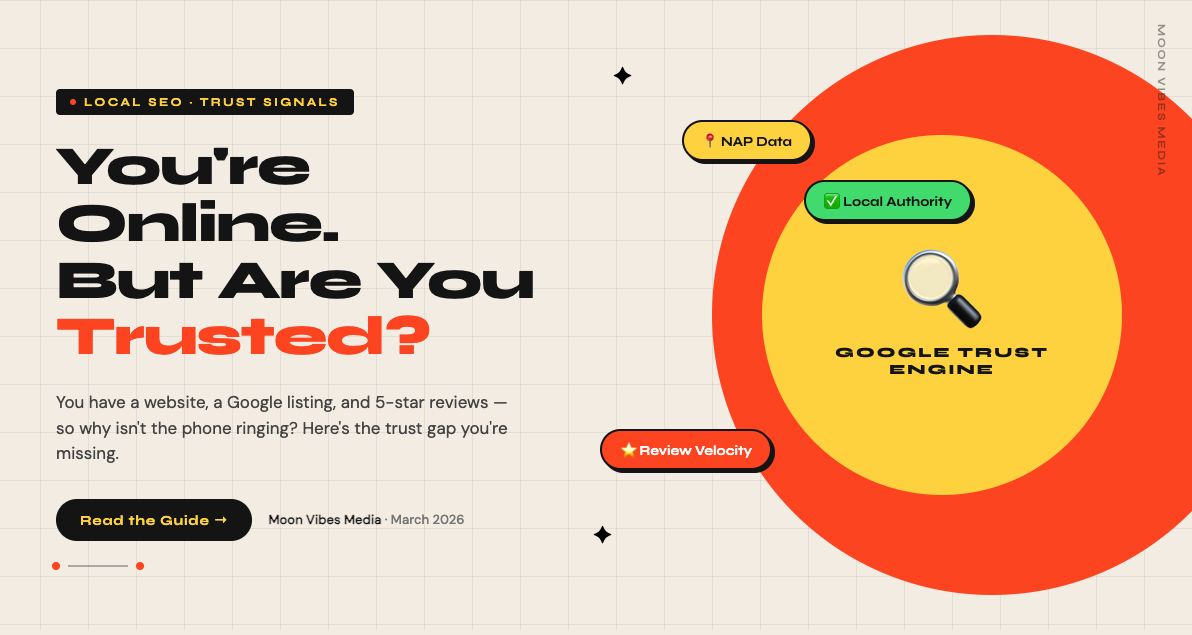
You checked the boxes. You have a website. You claimed your Google Business Profile. You might even have a handful of five-star reviews sitting there. By every measure, you exist online.
So why is the phone not ringing?
This is one of the most common and most demoralising positions a local business owner can find themselves in. You've invested time, maybe money, into building an online presence, and the return is silence. Meanwhile, your competitor two miles away seems to be everywhere.
Here's the hard truth: existing online and being found online are two completely different things. And the gap between them almost always comes down to trust.
Google Is Not a Directory, It's a Trust Engine
Most people think of Google Search as a place where businesses get listed. You claim your spot, fill in your details, and Google hands you to searchers. That's how it used to work.
Today, Google functions more like a background check. Before surfacing your business to someone searching for exactly what you offer, it runs a rapid-fire assessment of whether you're a credible, consistent, and authoritative answer to that query. If you pass, you get visibility. If you do not, you get buried, regardless of how long you've been in business.
"Being online is not the same as being trusted. And only trusted businesses get found."
This assessment is not arbitrary. Google looks for specific trust signals, patterns of data that, taken together, tell it whether you're a business worth sending their users to. And most small businesses, even ones that have "done the basics," are missing several of them.
The 4 Trust Gaps That Keep Local Businesses Invisible
1. Your NAP Data Is Inconsistent
NAP stands for Name, Address, Phone Number, the core identity data of your business. Google cross-references this information across dozens of sources: your website, your Google Business Profile, Yelp, Facebook, local directories, and more.
If your address appears as "14 High St" on your website but "14 High Street, Suite A" on Yelp and "14 High St." on your Google Profile, that inconsistency registers as a red flag. Not because any single variation is wrong, but because inconsistency suggests to the algorithm that your data might not be reliable.
Fix: Audit every listing where your business appears and standardise your NAP data exactly. Word for word. Character for character.
2. Your Google Business Profile Is Half Finished
Claiming your Google Business Profile is the first step, not the finish line. A profile with missing hours, no photos, an outdated description, and no responses to reviews tells Google, and more importantly, potential customers, that you're not actively managing your online presence.
Google rewards completeness and activity. Profiles with photos get significantly more direction requests and website clicks than those without. Profiles where the owner responds to reviews send a signal of engagement that factors into ranking.
Fix: Treat your GBP like a living asset, not a form you filed once. Add photos, keep hours accurate, post updates, and respond to every review, positive or negative.
3. You Have Reviews, But No Review Velocity
Twenty reviews accumulated over four years is not the same trust signal as twenty reviews accumulated over the last six months. Google interprets review velocity, how recently and consistently reviews are coming in, as a sign of an active, operating business.
A business with old reviews and no new activity looks like it might be closed, declining, or coasting. Fresh reviews signal that real customers are engaging with you right now.
Fix: Build review generation into your customer journey. A simple follow-up message after a completed job or appointment, asking happy customers to share their experience, can transform a static review count into a steady stream.
4. Your Website Has No Local Authority Signals
Your website is not just a brochure; it is a trust document. Google reads it to understand who you are, where you operate, and whether you have genuine expertise in your field.
Thin pages with no location-specific content, no mentions of your service area, no blog posts demonstrating expertise, and no external sites linking to you tell Google that you're a low-authority answer to local searches. Even if your services are excellent.
Fix: Create content that is genuinely useful to your local audience. Answer the questions your customers actually ask. Build pages that speak to specific neighbourhoods or communities you serve. And pursue citations, mentions of your business on relevant local and industry sites, to build external authority. This is exactly the kind of work we do through our local SEO and content strategy services.
The Compound Effect of Trust
Here is what makes this frustrating and exciting in equal measure: trust signals compound. Each one you fix makes the others more powerful. A complete GBP with accurate NAP data and fresh reviews, pointing to a well-structured website with local content, creates a credibility infrastructure that is genuinely difficult for competitors to replicate overnight.
This is why businesses that invest in trust building tend to hold their rankings more durably than those chasing short-term tactics. They've built something real.
THE KEY INSIGHT
The goal is not to game the algorithm, it is to become the most credible answer to the searches your customers are already running. When you achieve that, you stop chasing leads and start getting found by the people searching for exactly what you offer.
Where to Start This Week
You do not need to fix everything at once. Start with a NAP audit, Google your business name, and check every result for inconsistencies. That single action will surface the majority of your trust gaps and give you a clear prioritization list.
From there, work through your Google Business Profile completeness, then focus on review generation, and then tackle your website's local content. Each step builds on the last.
The businesses ranking at the top of local search in your category are not spending more than you. They're signaling more clearly than you. That is entirely fixable, and the gap closes faster than most people expect.
If you're ready to close those trust gaps and start getting found, explore our SEO and digital marketing services or get in touch for a free consultation.

Kyle Barron
Founder, Moon Vibes Media · Digital marketing strategist helping businesses grow with clarity and purpose.